Permits
Where Can a Dumpster Actually Go Around Here?
On your own driveway, almost always fine. On the street, the answer changes at every city line — and there are a lot of city lines here.
The short answer
If a temporary roll-off is going on your own driveway for the duration of a project, you are almost certainly fine without a placement permit. That covers the large majority of what we deliver.
If it has to sit on a public street, the answer depends entirely on which city you are in — and in the Quad Cities that question has more possible answers than almost anywhere we work.
Private property: a temporary roll-off
A driveway, a private parking area, a fenced construction site, a farmyard or a commercial lot you own or lease is private property, and a temporary container placed there for a project is not what municipal placement rules are aimed at.
Two caveats that are not placement permits but behave like them:
- The underlying work may need a building permit from your own city.
- If the property is a rental or has an association, their permission is not optional.
Our advice is always to get it onto private property where possible. Across the newer suburbs — Coal Valley, Bettendorf, Eldridge, much of Silvis — that is easy. In the older Rock Island and Moline streets and the narrow river villages along Route 84, it is sometimes genuinely not.
Useful numbers for judging your own frontage: a 20 yard is twenty-two feet of container and the truck needs roughly ten more feet of clear run behind it. A 15 yard takes six feet less on the ground.
⚠️ Street placement changes at every line
This is where the Quad Cities gets genuinely complicated, and where we would rather you asked than assumed.
We are being careful with the wording deliberately: these ordinances change, and the details are the city's to state rather than ours. What we can tell you reliably is that street placement is not a uniform question across the metro, that some cities regulate it through the hauler, and that the right order is to ask us before you plan around the street — we work across all of these municipalities and will tell you honestly what is possible and who to call.
There is also a straightforward practical reason to avoid the roadway here: snow. A container in the street through a Midwest winter is in the way of a plow, and on a graded street it is in the way of something with momentum.
Two states, three counties
The other thing that catches people, and it affects more than permits.
- Rock Island County, Illinois — Moline, East Moline, Rock Island, Silvis, Milan, Coal Valley, Carbon Cliff, Hampton, Andalusia, Rapids City, Port Byron. The free appliance and tire collection is a service of this county.
- Henry County, Illinois — Colona, Geneseo, Orion. Different county services.
- Scott County, Iowa — Davenport, Bettendorf, Eldridge, LeClaire. Different state entirely, and where the household hazardous waste facilities are.
Illinois municipalities here are cities and villages, with townships as a further layer of government. Moline, East Moline, Rock Island, Silvis, Colona and Geneseo are cities; Milan, Coal Valley, Carbon Cliff, Hampton, Andalusia, Rapids City, Port Byron and Orion are villages, governed by village boards. Iowa's are cities.
We confirm the address on every booking for exactly this reason, and if street placement turns out to be necessary we will point you at the right office first time.
The permits that actually matter
The container is rarely the regulated thing. These are:
- Building permits for the underlying work, from your own city
- Demolition permits, usually separate, and often carrying asbestos conditions
- Asbestos survey requirements before demolition on older buildings — with this much pre-1980 stock along the river, it comes up constantly
- Utility locates. Call 811 before any excavation — free, required, not optional
- Special waste pre-approval at the landfill for contaminated soils and industrial process waste, which needs starting well before the excavator arrives
Winter, grade and canopy
Three practical constraints that stop more deliveries here than permits do.
Winter. The big one. Snow banks narrow a driveway by a foot on each side, ice on a slope changes what a loaded truck can safely do, and a container can freeze to the ground — a real problem at collection. If your project runs through January or February, tell us, including where the plow pushes the snow.
Grade. Flat through most of the cities, but the bluff communities and the river villages — Coal Valley, Port Byron, Rapids City, LeClaire's hill — have real slopes. A loaded roll-off on a graded drive is worth planning rather than improvising.
Overhead branches. We need roughly twenty-two feet of clear height to raise the bed, and the mature canopy in the older neighborhoods is genuinely low in places. On a job with a mid-course swap it has to work twice.
Protecting the driveway
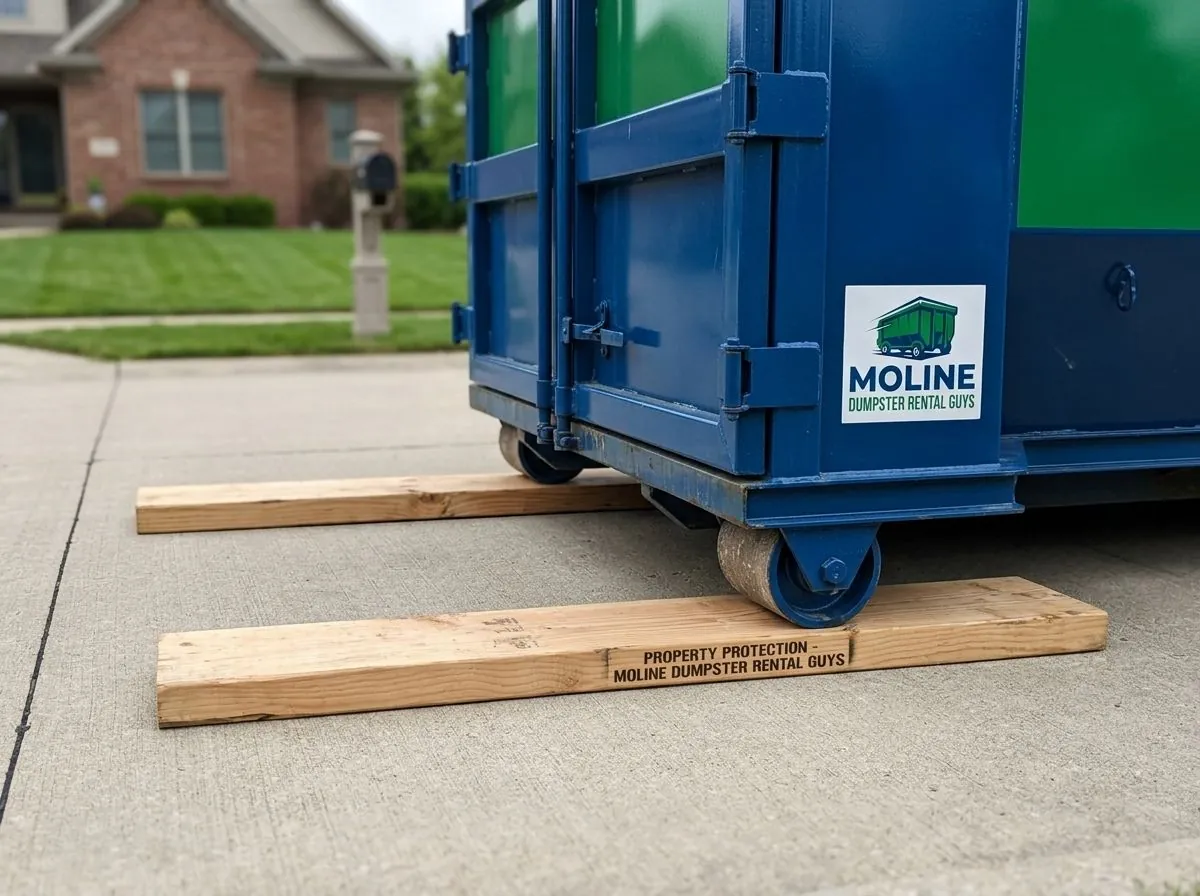
Boards go under the rails on every single delivery, without being asked and without a charge.
- Point loading is the risk, not total weight. The rails and wheels concentrate several tons into small contact patches.
- Older concrete slabs are common here and joints between them are where damage shows.
- Freeze-thaw has already worked on your driveway — Midwest winters do real damage to concrete and asphalt, and an already-cracked slab is more fragile than it looks.
- Freshly sealed asphalt needs to cure. If you have just had it done, tell us and we will find another spot or another date.
- Point us at the strongest part of the drive. You know where it cracks and we do not.
What we need from you
- Whether the container is going on private property or the street
- The full address — which city, which county, and which state
- Whether there is a landlord or association, and whether you have asked them
- Your driveway length, width, surface and grade
- Any branches, wires or low overhang near the placement
- Whether the underlying work is permitted
- In winter, where the snow has been pushed
We cannot pull street permission for you — it attaches to the property owner, the contractor, or in some cities to the hauler — but we work across all of these municipalities and can make sure you ask the right one first time.
Ordinances vary by municipality and change over time, and this service area spans two states and three counties. Everything above reflects how these jurisdictions generally operate at the time of writing. For anything consequential, confirm with your own city hall — and check first which city, county and state that actually is.
Need a container in Moline?
Call and describe the job. Three minutes on the phone gets you a size recommendation, a flat rate and a delivery window — and we will tell you if a smaller, cheaper container is the right answer.
Call (309) 281-7618